
A Bangladesh court on Thursday sentenced deposed prime minister Sheikh Hasina to 21 years in jail in three corruption cases related to irregularities in allocations of land in a government housing project.
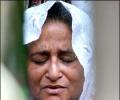
First look on Bangladeshi leader offering prayers at the Ajmer shrine.

Tarique Rahman is Bangladesh's first male prime minister in more than three decades, ending an era of female leadership that began in 1991.

Bangladesh's former premier Sheikh Hasina Wajed on Thursday left the country, a day after she was "temporary" released under an apparent deal cut with the military-backed government following 11 months in detention on graft charges. Thousands of party activists crowded Dhaka's Zia International Airport where the 60-year-old ailing Awami League leader arrived escorted by heavy security.
The murders took place in October 2006.
Awami league is Bangladesh's main opposition party and is headed by Sheikh Hasina Wajed.
Awami League chief Sheikh Hasina Wajed was on Tuesday sworn in as the new prime minister of Bangladesh, a week after her party led grand alliance swept the general elections, winning three fourths of the 300 parliamentary seats.President Iajuddin Ahmad administered the oath of office at Bangabhaban presidential palace, and the event was attended by over a thousand guests including the chief adviser of the interim government, Fakhruddin Ahmed.
Wajed has gone deaf in her right ear after suffering an injury in a grenade attack at a rally last year.
The joint forces also arrested the assistant personal secretary to former state minister for home affairs Lutfozzaman Babar and one of Babar's cousins.
She was supposed to return on April 23 but the caretaker government imposed a ban on her return, issued arrest warrant and asked the British Airways not to issue her a boarding pass. The ban was lifted on April 25.
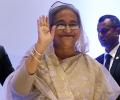
A court in Bangladesh has issued fresh arrest warrants against former Prime Minister Sheikh Hasina, her son Sajeeb Wajed, and 16 others in two cases related to alleged irregularities in allocating residential plots on the outskirts of the capital. The warrants were issued based on chargesheets filed by the Anti Corruption Commission (ACC), which alleges that Hasina and her family members illegally acquired plots in Purbachal New Town by abusing state power. The court has ordered police to submit a report by April 29 on the progress of executing the warrants. This is the latest in a series of legal actions against Hasina and her family members since her Awami League regime was toppled last year in a student-led mass uprising.

Videos on social media showed protesters climbing a statue of Hasina's father Sheikh Mujibur Rahman, a 1971 Liberation War hero, in Dhaka and smashing it with hammers.
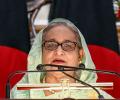
As news of Hasina's departure spread, hundreds broke into Hasina's residence, vandalising and looting the interiors, providing dramatic expression to the anti-government protests that have killed more than 100 people in the last two days. At the centre of people anger is the Hasina government's controversial quota system reserving 30 per cent jobs for families of veterans who fought the 1971 liberation war. With volatile crowds taking to the streets -- some clambering on Hasina's father and Bangladesh founder Sheikh Mujibur Rahman's statue and smashing it with hammers in a lasting image underscoring the fickleness of history -- Army chief General Waqar-uz-Zaman announced that the 76-year-old prime minister has resigned.
They alleged that free and fair polls were not possible under the present caretaker government.
The half-an-hour clip of the three-hour meeting between Prime Minister Sheikh Hasina Wajed and army officials on March 4, which was banned in the name of national interest, reveals the seething anger among army officials who openly shouted down the newly elected prime minister when she tried to justify her government's decision to negotiate with the mutineers rather than take military action.
The 81-year-old ex-president returned from Thailand a month after his "secret departure" sparked protests in Bangladesh for being allowed to leave despite being accused of murder.
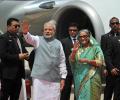
'When we have a terrorist outfit in a neighbouring nation, we need to do whatever we can to neutralise that threat,' says Ramananda Sengupta.
The central intelligence cell of the National Board of Revenue has sent a list of 55 people including Hasina and some charities to all commercial banks and the savings directorate with a direction to freeze their accounts.
